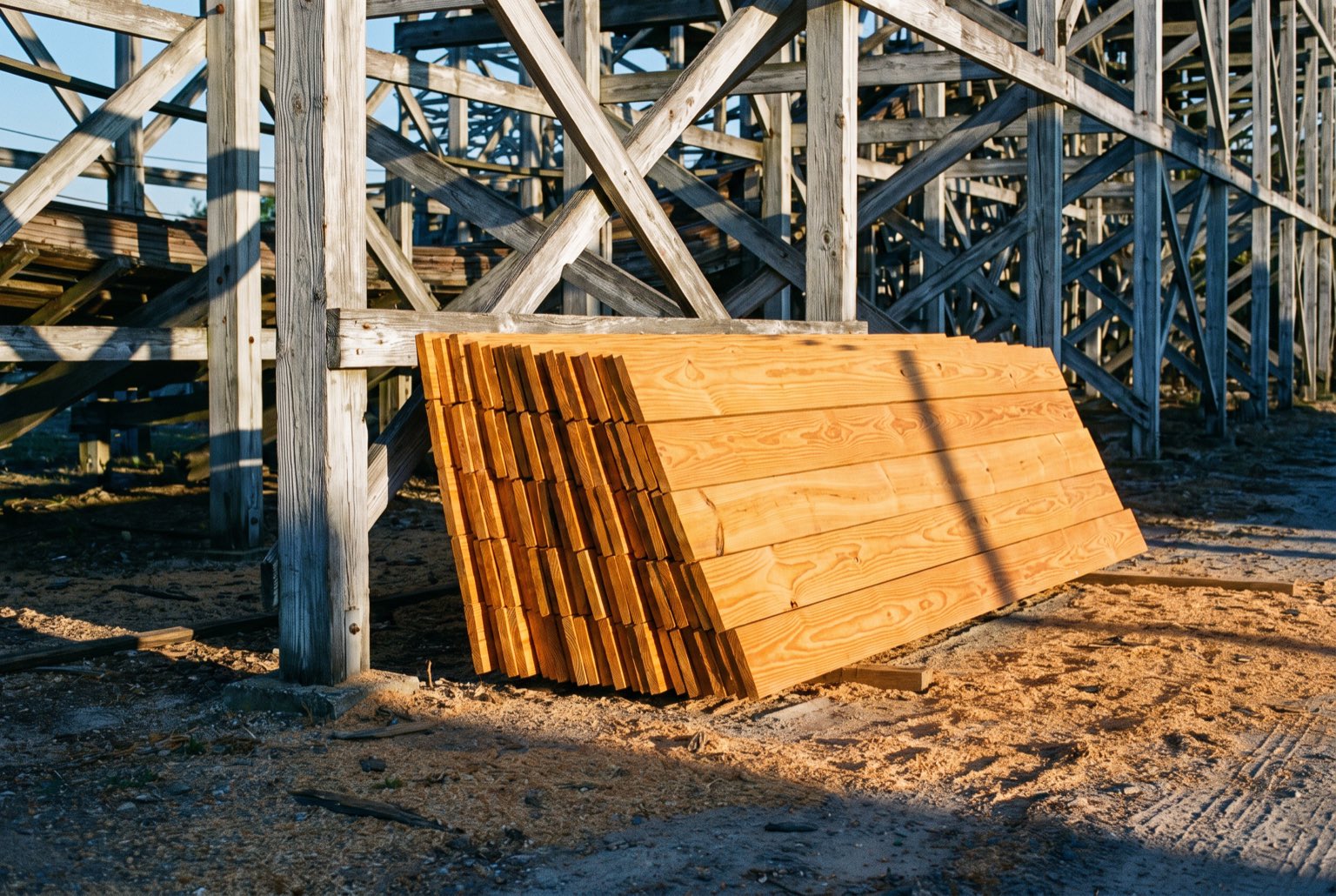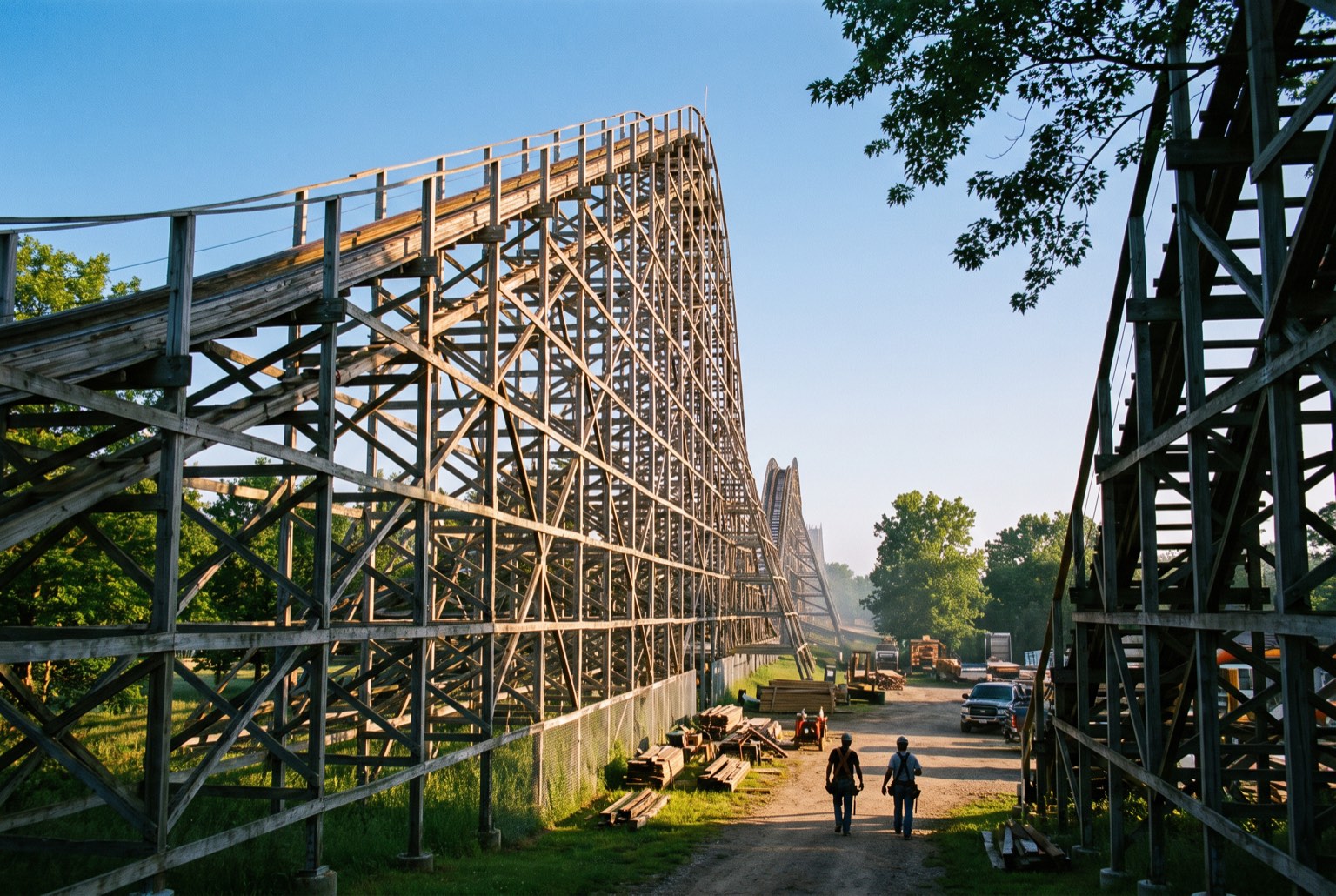
It is built to move.
A wooden coaster is not a structure that holds still. It is a structure that is allowed to move, and someone has to keep deciding how much.
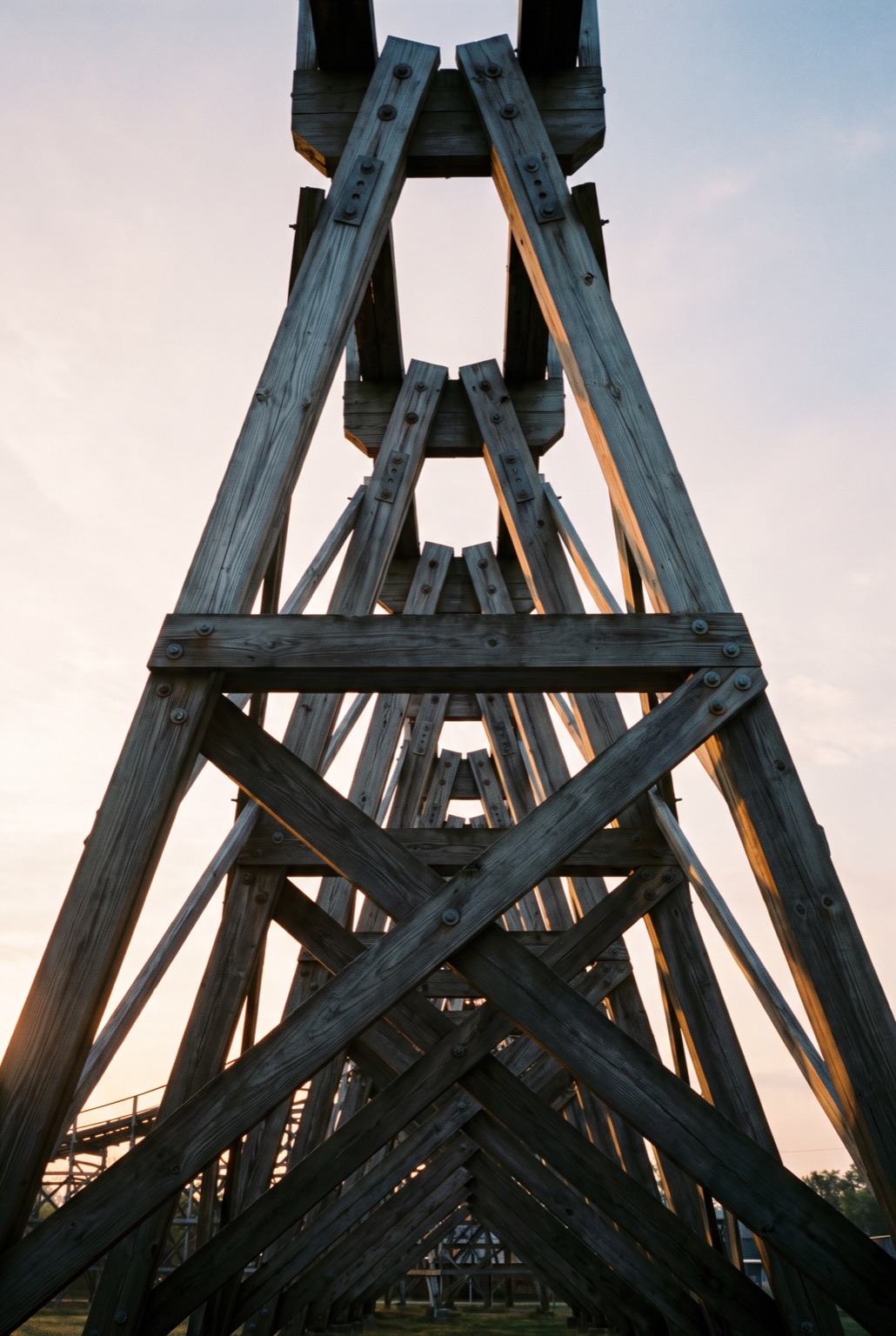
A bent is the unit.
Two raking legs, a ledger across them, an X of bracing between each level. Timber framers have called it a bent for four hundred years. A coaster is one bent, repeated, until it reaches the end of the land.
We build in southern yellow pine because it is stiff enough to carry the train and springy enough to give it somewhere to go. It is graded, pressure-treated, and cut on site. Every joint is bolted, never glued and never welded, because a bolted joint can be taken apart by the person who has to replace it in thirty years.
Wood is more work than steel, and it always will be. We are not going to pretend otherwise. What you get for the work is a ride that can be repaired by a carpenter instead of replaced by a foundry.
The Sway
Push the train across the bent. Watch it lean, and watch it come back. A wooden coaster built rigid would tear itself apart, because the energy would have nowhere to go.
In the band — the structure is taking it
- Deflection
- 3.1 in
- Load on this bent
- 14,600 lb
- Return to plumb
- 1.40 s
Right now: train on timber.
Below 1.5″, the joints take the shock instead of the timber, and they split. Above 4.5″, the train fights the track and will eventually valley. Too stiff is the failure nobody expects. Try an empty train on new timber and watch it fall out of the band the wrong way.
- steel running rail
- 12026
- 22026
- 32026
- 41998
- 51998
- 61998
- 71983
- 81983
- 91983
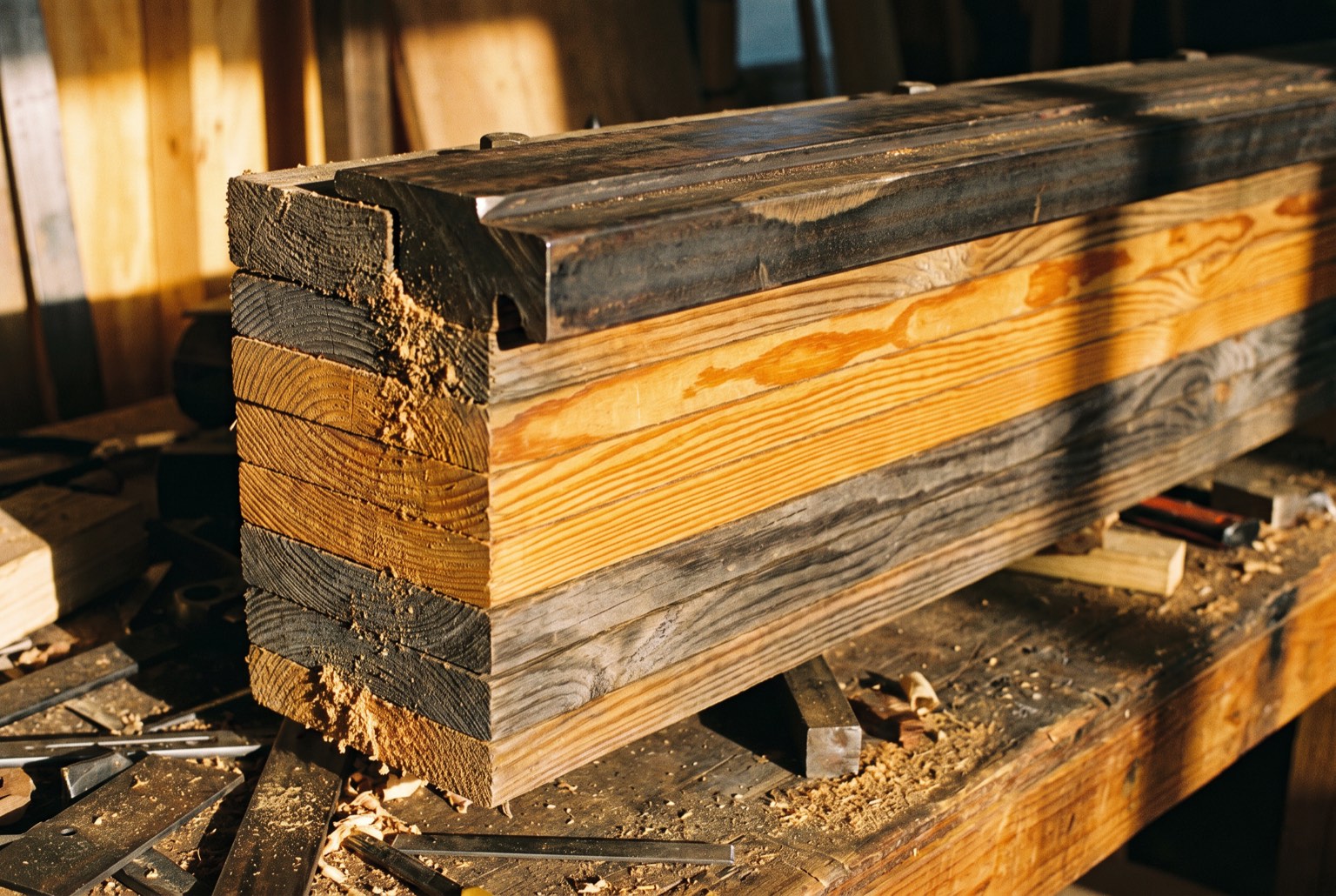
Gold = laid last spring. Layers 1 to 6 have all been cut out and replaced at least once; only 7, 8 and 9 are close to original.
The ride is not the wood.
Track is built up from nine layers of pine, laid one on top of the next and bent by hand around the curve. A steel running rail is bolted along the top edge — a strip a quarter of an inch thick, and the only steel in the whole assembly.
The top layers wear out. They are cut out and replaced, a few feet at a time, every spring, for as long as the ride stands. A coaster built in 1947 may contain almost none of its 1947 wood.
People find that sad. We do not. The ride is not the wood. The ride is the replacing. A structure that is maintained is a structure that is still loved, and the crew that shows up in March with a saw is the reason it is still standing.
Somebody walks it. Every morning.
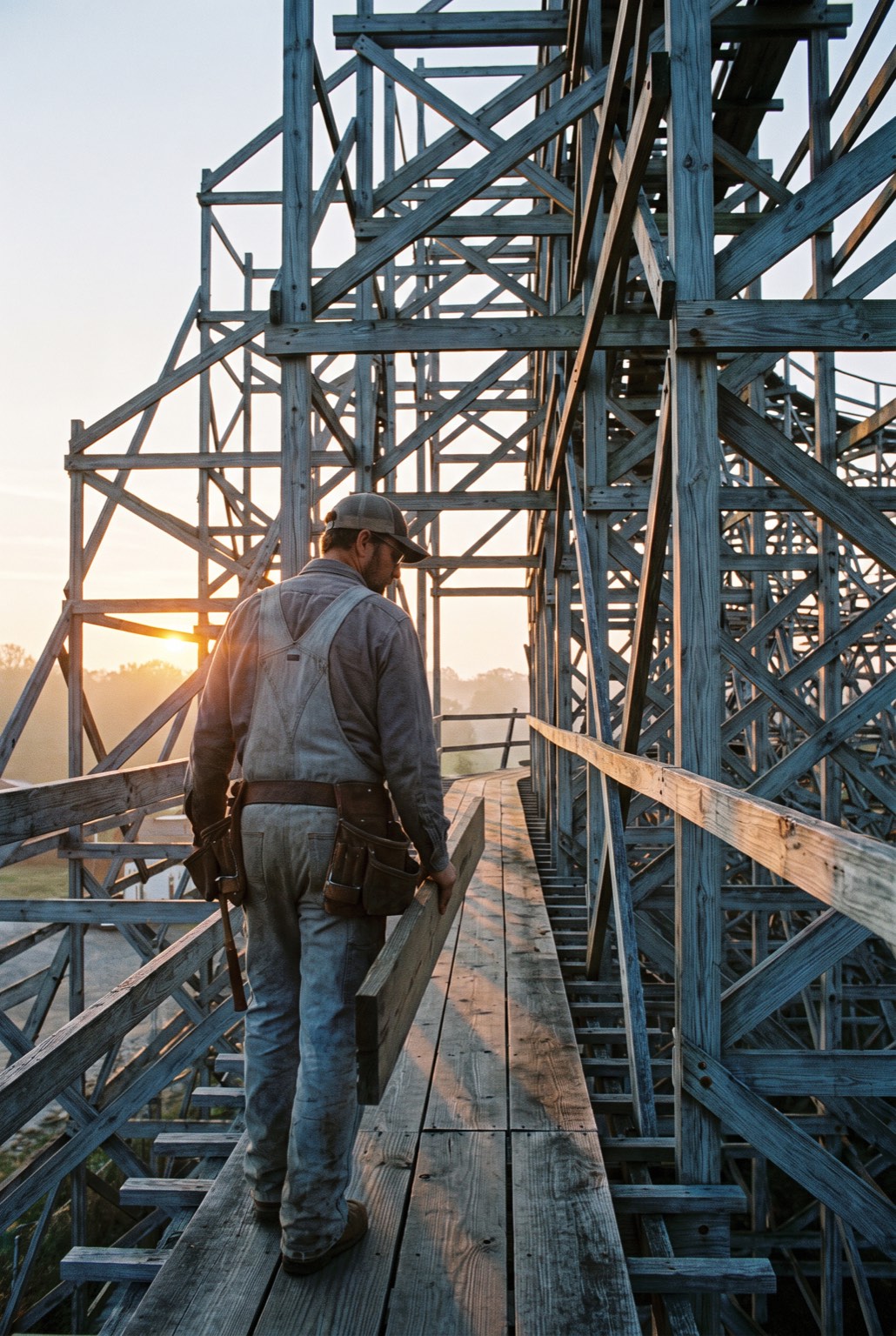
Before a single train runs, someone walks the whole circuit on the catwalk, in the dark end of the morning, looking at every joint they can reach. Loose bolt, split ledger, a rail end lifting, a board that has gone soft at the knot.
It takes about ninety minutes. It cannot be done from the ground, it cannot be done with a camera, and it has never once been done by a computer. It is the oldest job in this trade and it is still the one that matters most.
Eleven people work here. Three of them do nothing but walk and replace track.
Buy the wood that was replaced.
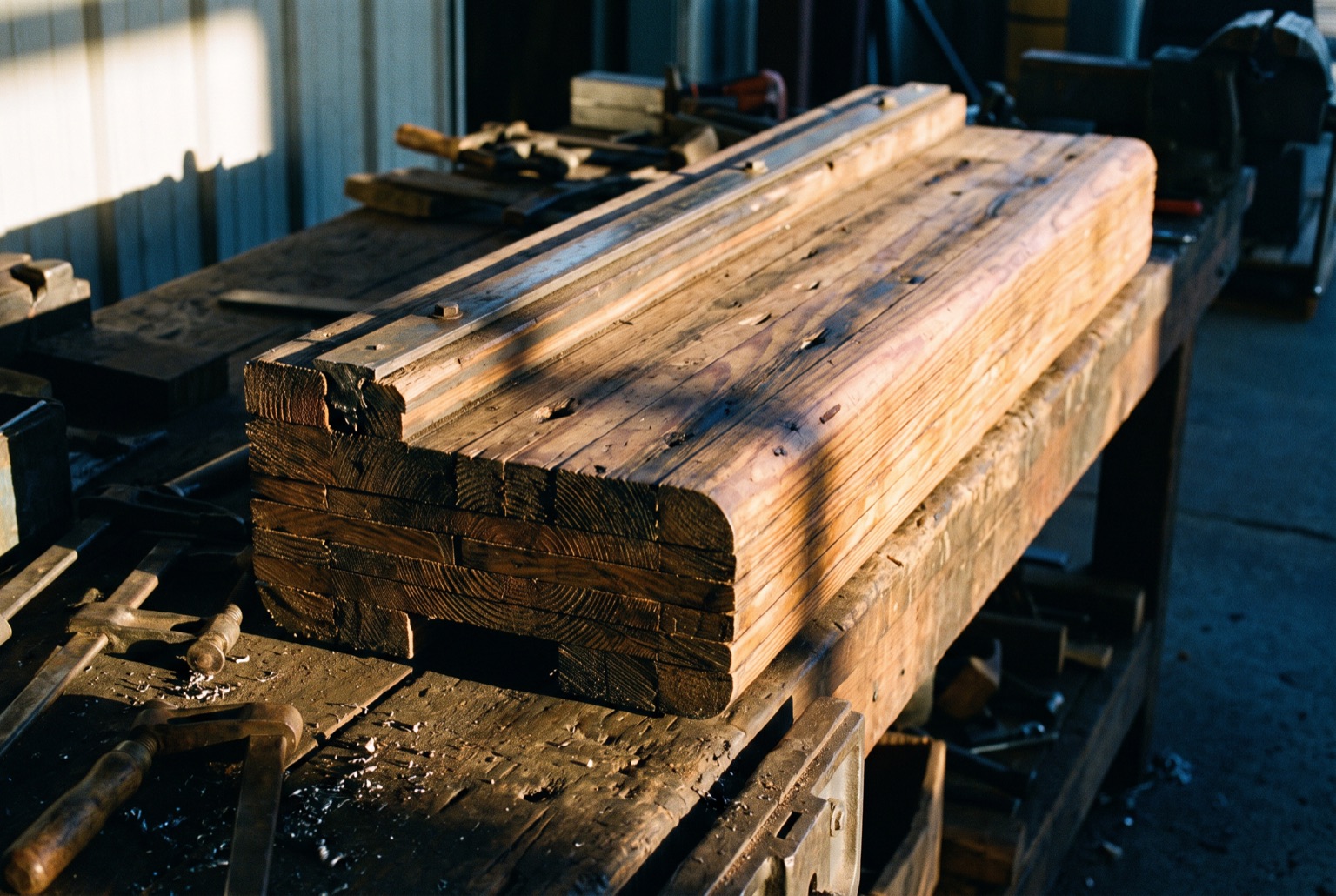
When we retrack a ride, the old track comes back here. We cut it into sections, clean it, and keep its record — which ride, which curve, the year it was laid and the year it came off, and roughly how many trains crossed it.
It is the only part of this trade you can own. Every piece has been under load for decades and is polished smooth on top by nothing but wheels.
A ride is a letter, not a form.
We cannot quote a coaster from a web page and we are not going to pretend we can. A ride is a survey, a soil report, a state inspector, two winters, and about twenty-two months.
Write to us with the park, the plot, and what you think you want it to do. If you have drawings, send them. If you do not, say so — most people do not.